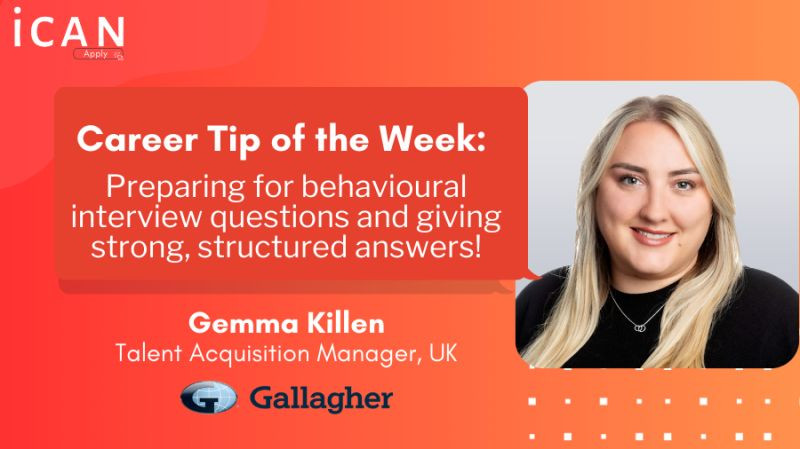
Prepare for Success: Interview Advice from Gallagher's Gemma Killen
Behavioural interview questions have become a key part of the recruitment process across the insurance industry. Rather than focusing solely on technical knowledge, employers want to understand how you've handled real situations, solved problems and worked with others.
Gemma Killen, Talent Acquisition Manager, UK at Gallagher, shares her advice on how candidates can prepare meaningful examples, structure their answers and approach behavioural interviews with confidence.
Reflect on Real Experiences
One of the biggest mistakes candidates make is trying to think of examples during the interview itself.
Instead, spend some time reflecting on situations where you've made a difference. These don't have to come exclusively from work. Experiences from education, volunteering, sports teams or other commitments can all demonstrate valuable skills.
Think about occasions where you've:
- Solved a difficult problem
- Worked successfully as part of a team
- Influenced an outcome
- Managed competing priorities
- Shown resilience during a challenge
Having genuine examples ready will help your answers feel authentic and confident.
Let the Job Description Guide Your Preparation
The job description isn't just there to explain the role. It's one of the best preparation tools you have.
Review it carefully and identify the key behaviours and competencies the employer is looking for. Then choose examples that clearly demonstrate those qualities.
Tailoring your answers to the role shows you've done your research and understand what's important to the employer.
Use the STAR Method
A well-structured answer is much easier for an interviewer to follow.
Gemma recommends using the STAR method:
- Situation – Explain the context.
- Task – Describe what needed to be achieved.
- Action – Focus on what you did.
- Result – Share the outcome and what you learned.
The Action section is often the most important, as it demonstrates your approach, decision-making and problem-solving skills.
Build a Bank of Examples
Rather than preparing an answer for every possible interview question, create a small collection of strong examples that can be adapted for different situations.
Aim to have examples covering topics such as:
- Teamwork
- Problem-solving
- Resilience
- Influencing others
- Leadership
- Delivering results
Many behavioural questions overlap, so one example can often be adapted to answer several different questions.
Focus on Your Contribution
When describing examples from team projects, make sure your own contribution is clear.
It's natural to say "we" when discussing collaborative work, but interviewers also want to understand the specific role you played.
Explain the actions you took, the decisions you made and what you learned from the experience. This helps employers understand the value you personally bring to a team.
Visit www.icanapply.uk for more job listings, recruiter insights, and practical career advice.